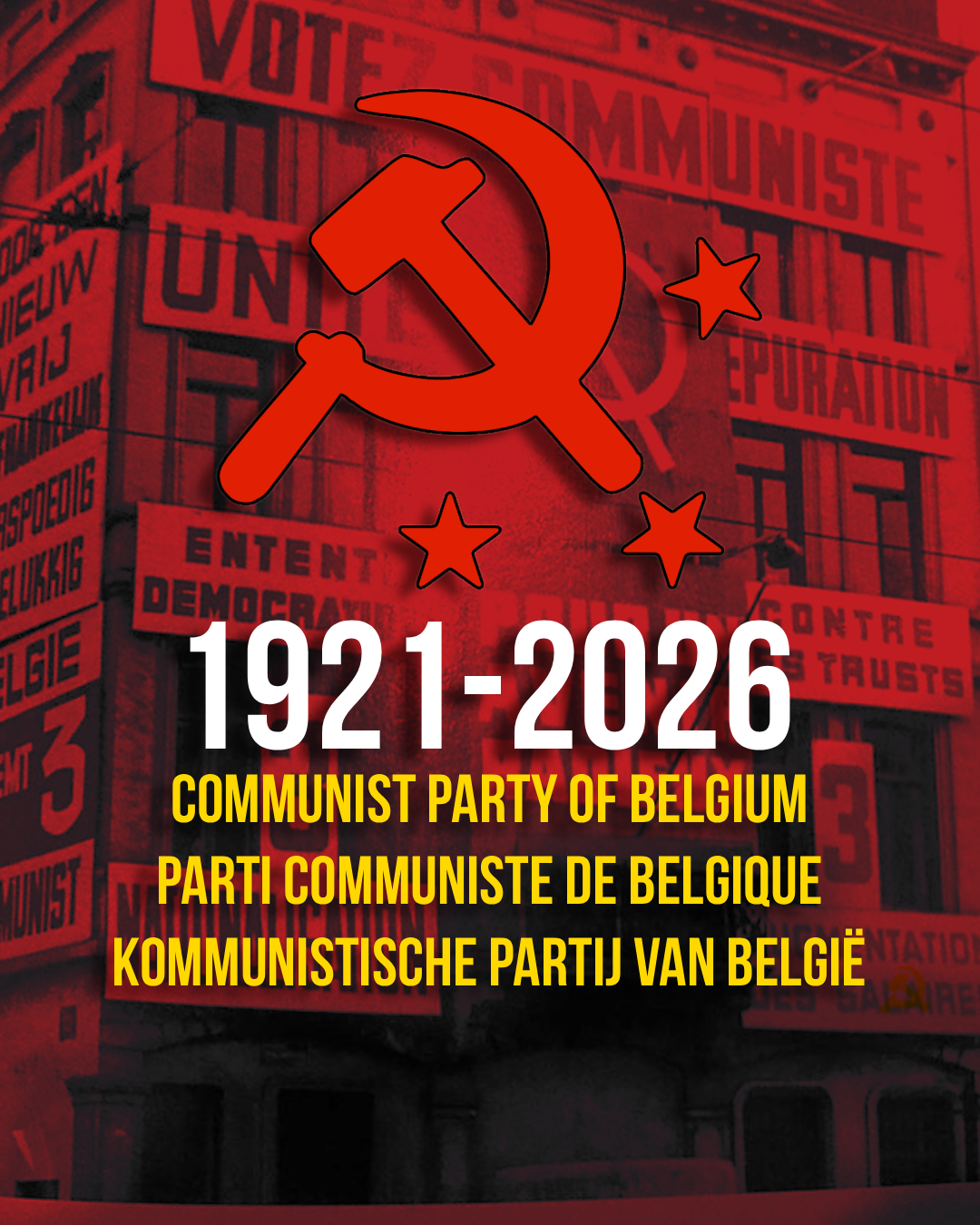
Between 3-4 September 1921 the Merger Congress of the United Communist Party of Belgium (henceforth known as the Communist Party of Belgium or CPB) took place in Brussels, uniting the formerly separate Belgian Communist Party (BCP) and Communist Party of Belgium (not to be confused with the CPB that succeeded it) into a single organization.
In 1918, at the end of the First World War, an eclectic group of “minority socialists” had formed within the social-democratic Belgian Workers’ Party (BWP) which was broadly opposed to its participation in the imperialist war and in the so-called government of national unity. Among them were anti-parliamentary socialists, flamingants, pacifists and an even smaller group of Marxists who – inspired by the October Revolution – stood against the patriotic fervor which had infected the workers’ movement.
The first to officially split from the BWP were the dissident sections of its youth wing, the Socialist Young Guards, who formed themselves into the Flemish Revolutionary Socialist Party (later renamed to the Communist Union) and the Communist Federation of Wallonia-Brussels respectively. In 1920 these two groups merged into the BCP, which began publishing L’Ouvrier Communiste as its newspaper. One of its most prominent members was the artist War Van Overstraeten, who had earlier visited Soviet Russia and was later sent as a representative to the Second Congress of the Communist International (Comintern). But while the BCP was perhaps the most theoretically developed communist group in Belgium at the time, its members lacked experience and had only a limited connection with the workers’ movement.
Another group had emerged within the BWP around the newspaper L’Exploité (later renamed to Amis de L’Exploité), which had begun publishing around 1911 but had been banned under the occupation before reemerging in 1918. It originally aligned itself with the centrists of the Second International, who rejected the Leninist slogan of “turning the imperialist war into a civil war” in favor of a “peace without annexations”. The group also refused to openly break with the opportunism of the BWP and instead used the entryist tactic of remaining within the party as a faction for as long as possible to maximize its future membership. But as the group became more and more revolutionary, and internal opposition became less and less possible, a decision was made in 1920 to officially split from the party, forming the Communist Party of Belgium. One of its most prominent members was the trade unionist Joseph Jacquemotte. Originally a syndicalist, Jacquemotte was introduced to Marxism only at the beginning of the imperialist war and undertook no serious theoretical study. Instead, he focused more on immediate practical tasks such as leading strikes, a tendency which was more broadly reflected in the relative theoretical underdevelopment of the CPB but also in its closer connection to the workers’ movement.
In the debate that followed Jacquemotte and the Communist Party of Belgium were criticized for their hesitation in splitting from the BWP and their decision to form an independent organization instead of joining the already existing BCP, who accused them of vacillating between Marxism and opportunism. But with the spread of the revolution still seeming a possibility, the Comintern proposed an immediate merger of the two organizations as a condition of membership, and appointed Grigory Zinoviev to mediate between them. In 1921 a program was decided and the two organizations merged into the United Communist Party of Belgium (henceforth known as the Communist Party of Belgium or CPB). At the moment of its formation, the CPB was both numerically small and theoretically underdeveloped, including as its members not only Marxists but also anarchists and syndicalists.
Having united the theoretical and practical vanguard within itself, the formation of the CPB was not the end but the beginning of the development of the Communist Party as an objective social relation between the vanguard and the masses of the proletariat. Subjectively however the CPB remained ignorant of this and continued to define the Communist Party by its form – the vanguard organization – instead of its content.
The next few years of its existence were characterized by an intra-party struggle that drove its internal theoretical and practical development, eventually resulting in a rapid increase in membership and influence over the masses of the proletariat. And the relative theoretical underdevelopment of the CPB remained, which was increasingly expressed through tactical and eventually strategic defeats such as the attempt to form a Popular Front and the brief entry of the party into bourgeois government in 1944. It’s reflexive priority of short-term tactical victories over long-term strategic victories, its increasing inability to study and resolve new contradictions and its dependence on the Communist Party of the Soviet Union created the conditions in which opportunism and revisionism developed and became hegemonic. Having sacrificed the will for Communism on the altar of necessity, the CPB collapsed under its own weight. The adoption of Khruschevite revisionism at the Congress of Vilvoorde in 1954 was not the beginning but the culmination of the decay which had rotted the party from the inside, leaving it blind and deaf.
In the next decades of its existence, the CPB became nothing more than another social-democratic party under the misleading name of Eurocommunism, before shattering into a multitude of different organizations in 1989, of which none have been relevant enough to name here.
So, what can we learn from the history of the CPB? It is obvious to most that the bourgeoisie has attempted to, and at least moderately succeeded in, erasing Communism from Belgian history. Its leadership in the workers’ movement, the anti-fascist resistance and its support of the resistance against Belgian colonialism. But what is perhaps less obvious and more serious is the lack of knowledge which the Communist Movement in Belgium has of its own history today. The fetishization of the past, its aesthetics and its symbols, still precludes any serious critical discussion on the history of the CPB apart from those who merely attempt to slander it.
There are still those who claim to be a “descendant” of the CPB, as if it is some feudal title which can be “inherited” by lineage. But to recover the revolutionary aspect of the CPB, it is necessary to critique the reactionary aspects which resulted in its defeat.
A precondition for the Reconstitution of Communism is the understanding that history cannot be repeated, and that the conditions for the Reconstitution of the Communist Party are different from those of its initial constitution. Not only must we overcome the contradictions which the CPB was unable to resolve, but also those which have been created by the mystification of its history. We can have no sentimentality for the relics of the past, no comfort in aesthetics and no undue respect for the “great men” of history.
We have only one measure: that which brings humanity closer to Communism, and that which does not.
For the Reconstitution of Communism!
Proletarians of all countries, unite!


